
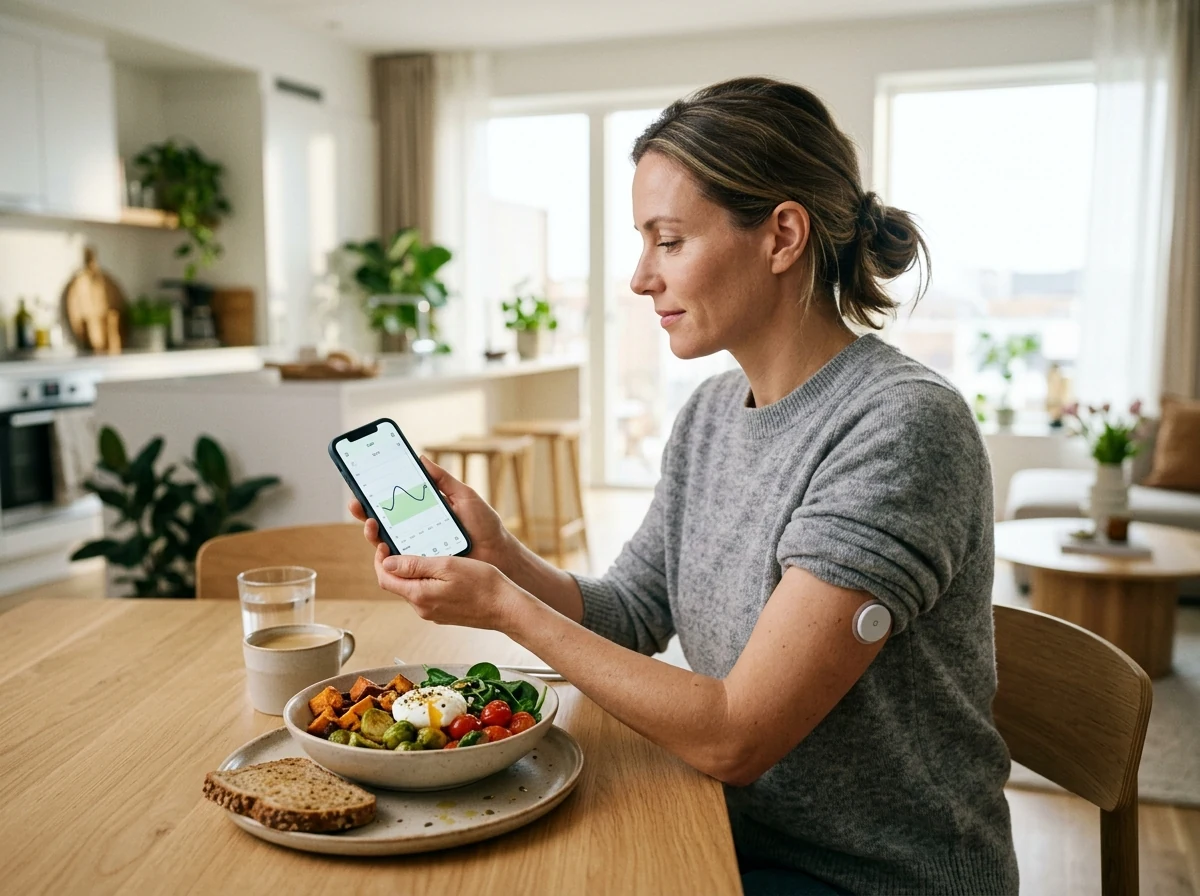
Continuous glucose monitoring systems, or CGMs, have long been important tools in diabetes management. In recent years, however, they have also become increasingly visible among people who do not have diabetes.
A sensor is placed, a glucose curve appears on a smartphone throughout the day, and questions quickly follow:
“This meal caused a glucose spike. Is it bad for me?”
“This meal kept my curve flatter. Is it healthier for me?”
“My sensor read low overnight. Do I have hypoglycemia?”
“Can CGM detect prediabetes earlier?”
These questions are understandable because CGM produces detailed, continuous data.
The key scientific point, however, is:
More data does not automatically mean better clinical interpretation.
The value of CGM in diabetes care is well established. In healthy people without diabetes, by contrast, the clinical significance of specific CGM patterns, the thresholds that indicate risk, and whether nutrition changes based on CGM improve long-term health outcomes are far less clearly established. [1], [2], [3]
For that reason, CGM should neither be dismissed as a meaningless gadget nor treated as a personal “metabolic diagnosis” for every curve.
What does CGM actually measure?
A CGM sensor does not continuously sample glucose directly from a vein.
Most modern systems measure glucose in interstitial fluid beneath the skin and convert that signal into an estimated glucose value using device algorithms. [1], [4]
This distinction matters.
When blood glucose changes quickly, interstitial glucose may lag behind by several minutes. Physiologic lag is generally on the order of several minutes, while device filtering and algorithms can contribute additional dynamics. [4]
So, at the same moment:
- venous laboratory glucose,
- finger-stick capillary glucose,
- sensor glucose
do not necessarily have to show exactly the same number.
A difference does not automatically mean the sensor is defective. But it also means a single sensor reading should not always be treated as if it were a laboratory reference value.
Why can a sensor differ from a blood glucose measurement?
Differences can arise from:
- physiologic delay between blood and interstitial fluid,
- rapidly rising or falling glucose,
- early sensor wear,
- device algorithms,
- pressure on the sensor,
- temperature or circulation changes,
- device-specific interfering substances,
- technical variation between sensors.
A 2024 accuracy study in healthy young men using FreeStyle Libre 2 reported an overall mean absolute relative difference of about 12.9%. That does not make the device useless. It simply reminds us that every individual number on the screen is not “laboratory truth”. [5]
What is a “glucose spike”?
“Glucose spike” is widely used on social media.
However, there is no single universally accepted, clinically validated threshold that defines a harmful post-meal “spike” in healthy people without diabetes.
Glucose rising after a meal is part of normal physiology. Carbohydrates are digested, glucose is absorbed, insulin is secreted, and glucose is then used or stored.
That process itself is not disease.
The problem arises when the concept is simplified into:
“If the glucose line is not flat, the meal is harmful.”
That conclusion goes beyond the evidence.
Do healthy people have post-meal glucose rises?
Yes.
CGM studies in healthy individuals show that glucose is not completely flat throughout the day.
A 2019 multicenter prospective study followed 153 healthy children and adults without diabetes using Dexcom G6 for up to 10 days. Average sensor glucose was around 98–99 mg/dL for most age groups, but participants still spent small amounts of time above 140 mg/dL and occasionally higher. [6]
Other studies have also documented postprandial excursions in normoglycemic adults. [7]
Therefore:
“My sensor rose after a meal, so my metabolism is abnormal.”
cannot be concluded from the rise alone.
Is there a standard definition of “normal CGM” for healthy individuals?
Not yet in the same way as there is for diabetes management.
In diabetes, commonly used CGM metrics include:
- Time in Range,
- Time Above Range,
- Time Below Range,
- mean glucose,
- glucose variability,
- Glucose Management Indicator.
These metrics were developed primarily for diabetes management.
The 2026 ADA Standards of Care state that there is currently insufficient evidence to support CGM for screening or diagnosing prediabetes or diabetes. Validated A1C, fasting plasma glucose and oral glucose tolerance testing remain the standard diagnostic approaches. [8]
Even for prediabetes, recent reviews note that consensus CGM goals and high-quality evidence remain limited. [9]
That is why diabetes treatment targets should not simply be rebranded as “optimal metabolic targets” for healthy people.
What do reference studies in healthy people tell us?
Reference studies show that perfect flatness is not required for health.
Healthy cohorts generally show:
- normal average glucose,
- lower variability than diabetes populations,
- very little time above 180 mg/dL,
- occasional sensor values below 70 mg/dL in some people.
Two cautions are important.
First, different studies use different sensors and inclusion criteria.
Second, low sensor values can be influenced by technical performance, particularly at lower glucose levels, and by pressure-related artifacts during sleep.
A healthy reference distribution is not the same thing as a validated treatment target.
Does a low overnight sensor reading mean hypoglycemia?
Not always.
Sleeping directly on the sensor can sometimes create a falsely low reading, often called a compression low.
Sensor performance can also differ from reference blood glucose at lower values.
If a person has no symptoms but repeatedly sees surprisingly low overnight values, those data should be interpreted cautiously. If clinical decisions are needed, appropriate capillary or laboratory confirmation may be necessary.
One isolated overnight graph is not enough to diagnose “hidden hypoglycemia”.
Does everyone respond to the same meal in the same way?
No.
One of the most interesting findings in precision-nutrition research is that postprandial glucose responses vary between individuals.
The 2015 Zeevi study and the 2020 PREDICT 1 study demonstrated substantial interindividual variation in responses to similar or standardized meals. [11], [12]
PREDICT 1 studied 1,002 adults and measured glucose, triglyceride and insulin responses in the clinic and at home. Considerable between-person variability was observed even after identical meals. [12]
That is scientifically important.
But it does not prove:
“Everyone should wear a CGM and eat only according to their glucose curve.”
Personalized nutrition is broader than a single glucose trace.
Does the same person respond identically to the same meal every day?
Not necessarily.
Post-meal glucose can be influenced by:
- amount and type of carbohydrate,
- fiber,
- protein and fat,
- meal sequence,
- the previous meal,
- physical activity,
- sleep,
- stress,
- time of day,
- illness,
- some medications,
- hormonal context,
- measurement error.
So a higher curve on Monday and a lower curve on Wednesday should not automatically be attributed entirely to one food.
If a food raises my glucose, is it “bad for me”?
Not by that fact alone.
Foods such as:
- fruit,
- legumes,
- whole grains,
- milk or yogurt,
- starchy vegetables
contain carbohydrate and can create a glucose response.
Yet the health value of a food is not determined solely by its two-hour glucose curve.
The food may also contribute:
- fiber,
- vitamins,
- minerals,
- protein,
- fatty acids,
- phytochemicals,
- satiety,
- diet quality.
Eliminating a nutritious food simply because a sensor line rises may remove the data from its nutritional context.
Is a flatter glucose curve always healthier?
Not necessarily.
Reducing carbohydrate sharply or adding more fat can flatten some post-meal glucose curves.
But flattening the CGM curve does not automatically improve:
- total energy intake,
- saturated-fat intake,
- fiber intake,
- nutrient density,
- body weight,
- blood lipids,
- long-term cardiometabolic risk.
For that reason, “the flattest curve = the healthiest meal” is not a sufficient scientific rule.
What do PREDICT studies tell us about personalized nutrition?
PREDICT 1 showed that postprandial responses are influenced by more than macronutrient content and that person-to-person variation can be large. [12]
This is important for precision-nutrition research.
However, PREDICT should not be translated into:
“A CGM alone can tell you exactly which foods are good or bad for you.”
The study included glucose alongside triglycerides, insulin, anthropometry, lifestyle, microbiome data and other variables.
Personalization should not be reduced to one sensor graph.
Can CGM help healthy people change behavior?
Possibly, but the evidence remains limited.
A 2026 systematic review and meta-analysis of CGM use in people without diabetes included 23 studies and 1,074 participants. CGM sometimes supported behavioral awareness and adherence in structured lifestyle interventions and produced a small effect on mean glucose. However, there was no significant advantage for BMI, and healthy normoglycemic populations did not show an appreciable glycemic benefit. [13]
So statements such as:
“CGM makes you lose weight.”
or:
“CGM improves metabolism in every healthy person.”
are not supported.
Is CGM a weight-loss tool?
CGM is not an energy-balance device.
Body-weight change depends on:
- energy intake,
- energy expenditure,
- body composition,
- sleep,
- physical activity,
- environmental and behavioral factors,
- medical conditions.
CGM may provide feedback that increases awareness in some people, but wearing a sensor by itself does not produce weight loss. The 2026 meta-analysis found no significant BMI advantage in people without diabetes. [13]
Focusing only on glucose can also distract from total energy intake and overall diet quality.
Can CGM diagnose prediabetes?
Not as a validated standard diagnostic method.
According to the 2026 ADA Standards of Care, validated diagnostic tests for diabetes and prediabetes include:
- A1C,
- fasting plasma glucose,
- 2-hour plasma glucose during a 75-g OGTT,
- random plasma glucose in the appropriate clinical setting.
Evidence remains insufficient to support CGM for screening or diagnosis of prediabetes or diabetes. [8]
Seeing a few sensor readings above 140 or 180 mg/dL therefore does not establish a diagnosis of prediabetes.
Conversely, a “normal-looking” CGM trace does not definitively exclude prediabetes.
Can Time in Range be applied to healthy people?
Time in Range is a highly useful clinical metric in diabetes care.
The 2026 ADA standards use CGM metrics to support treatment decisions in diabetes. [1], [14]
However, using diabetes thresholds such as:
- 70–180 mg/dL Time in Range,
- Time Above Range,
- Time Below Range
as direct “optimal metabolic health scores” for healthy people has not been adequately validated.
Reference distributions and treatment targets are not the same thing.
What is glucose variability?
Glucose variability refers to several statistical measures describing how much glucose changes over time.
High glycemic variability has clinical importance in diabetes.
In healthy people, however, we do not yet know exactly which degree of everyday variability independently predicts long-term risk or whether minimizing sensor variability improves health outcomes.
Pursuing an artificially low variability score at the expense of dietary quality may therefore be unhelpful.
Why do sensor accuracy limits matter?
Because CGM can create an illusion of extreme precision.
A screen may display:
`92 mg/dL`
which can feel like an exact laboratory value.
But sensors have measurement error.
A 2024 study in healthy adults reported a MARD of about 12.9% for FreeStyle Libre 2. Other studies in normoglycemic people have also found differences between CGM and capillary or plasma glucose. [5], [15]
That does not make CGM useless.
It does mean that interpretations such as:
“101 is good, 109 is bad.”
are not scientifically justified.
When should sensor data be interpreted especially cautiously?
Examples include:
- first day of sensor wear,
- rapidly changing glucose,
- exercise,
- dehydration,
- pressure on the sensor,
- unexpected overnight low values,
- use of a substance known to interfere with a specific device,
- mismatch between symptoms and sensor reading.
Clinical decisions should not be based only on an app graph when symptoms or safety are involved.
Can CGM increase anxiety or unnecessary restriction?
This possibility deserves attention.
For some people, glucose feedback may improve awareness.
For others it can lead to:
- fear of every rise,
- unnecessary carbohydrate restriction,
- avoiding fruit,
- repeated checking after meals,
- pursuing a perfectly flat line,
- anxiety around eating.
Long-term evidence about psychological harms in people without diabetes is limited, so extra caution is reasonable in people with a history of disordered eating or excessive health anxiety. [3]
Does that mean CGM has no place in personalized nutrition?
That would also be too strong.
When used for a well-defined question and interpreted appropriately, CGM may help:
- visualize post-meal glucose patterns,
- observe the effect of activity,
- compare meal patterns in a structured context,
- provide an additional data stream during professional assessment.
But CGM is not a complete personalized-nutrition system by itself.
Personalized nutrition also considers:
- medical history,
- laboratory findings,
- anthropometry,
- sleep,
- physical activity,
- medication,
- food preferences,
- gastrointestinal tolerance,
- sustainability,
- individual goals.
In which non-diabetic populations is CGM being researched?
People without diabetes are not one homogeneous group.
Research has examined CGM in groups such as:
- prediabetes,
- obesity,
- elevated metabolic risk,
- selected endocrine conditions,
- previous gestational diabetes,
- people at high risk of developing diabetes.
Promising research does not mean:
“CGM should be routinely recommended to every healthy adult.”
Do experts always agree when reading CGM reports from people without diabetes?
No.
A 2026 study asked 18 CGM experts to review 20 potentially challenging reports from people without diabetes. There was incomplete agreement about which patterns warranted follow-up. [17]
This finding is instructive.
If expert interpretation of some CGM patterns in people without diabetes is not yet fully standardized, an automated app color code should not be treated as a definitive judgment that:
“This meal is bad.”
A Scientific Note from Doğa Akçayöz
I find CGM data interesting because individual responses to the same meal can genuinely differ.
However, I do not think personalized nutrition should be reduced to the glucose curve alone.
A meal may create a higher short-term glucose peak while still contributing:
- fiber,
- high-quality protein,
- vitamins and minerals,
- satiety,
- long-term dietary quality.
In addition, a sensor is not a perfect camera of biological reality. It measures interstitial glucose and has technical error.
So, for me, the useful question is not only:
“How high did my glucose rise after this meal?”
A more meaningful question is:
“What does this data mean when considered together with the person’s clinical context, laboratory findings, diet quality, physical activity and goals?”
Frequently Asked Questions
Is it normal for glucose to rise after a meal in a healthy person?
Yes. A rise after carbohydrate-containing food is physiologic. The meaning of an excursion depends on magnitude, duration, overall metabolic context and measurement accuracy.
Is seeing 140 mg/dL on CGM bad?
A single sensor value of 140 mg/dL does not by itself diagnose disease or define a harmful “spike” in a healthy person. Reference patterns and clinical meaning in people without diabetes are still being standardized. [6], [10]
Can CGM diagnose prediabetes?
CGM is not a validated standard diagnostic test for prediabetes. The ADA states that evidence is insufficient for using CGM to diagnose prediabetes or diabetes. [8]
Are foods that produce the lowest glucose rise always the healthiest?
No. Short-term glucose response is only one characteristic of food. Fiber, protein, micronutrients, energy and overall diet quality also matter.
Does CGM help with weight loss?
It may support awareness in some people, but CGM itself has not been shown to produce weight loss. The 2026 meta-analysis found no significant BMI benefit. [13]
What if my sensor reads very low overnight?
One unexpected low reading may reflect sensor pressure or measurement differences rather than true hypoglycemia. If lows recur or symptoms occur, discuss them with a healthcare professional and confirm appropriately when needed.
Conclusion
CGM is a powerful and interesting technology.
In healthy people without diabetes:
- every glucose rise is not disease,
- every “spike” cannot be labeled harmful,
- diabetes CGM targets cannot simply be applied to healthy people,
- CGM alone does not diagnose prediabetes or diabetes,
- sensor measurements have technical limitations,
- one meal curve does not prove that a food is “good” or “bad” for an individual.
The central scientific message is:
CGM produces a great deal of data, but the value of that data depends on correct clinical and nutritional interpretation.
The goal of personalized nutrition is not to create the flattest possible glucose line. It is to integrate metabolic health, diet quality, sustainability and the person’s actual clinical needs.
Scientific References
- American Diabetes Association Professional Practice Committee 7. Diabetes Technology: Standards of Care in Diabetes—2026 Diabetes Care. 2026;49(Suppl 1):S150–S180. Source link ↗ DOI: 10.2337/dc26-S007 ↗
- American Diabetes Association Professional Practice Committee 2. Diagnosis and Classification of Diabetes: Standards of Care in Diabetes—2026 Diabetes Care. 2026;49(Suppl 1):S27–S46. Source link ↗ DOI: 10.2337/dc26-S002 ↗
- Oganesova Z, Pemberton J, Brown A Innovative solution or cause for concern? The use of continuous glucose monitors in people not living with diabetes: A narrative review Diabetic Medicine. 2024;41(9):e15369. PubMed ↗ DOI: 10.1111/dme.15369 ↗
- Rebrin K, Sheppard NF Jr, Steil GM Use of subcutaneous interstitial fluid glucose to estimate blood glucose: revisiting delay and sensor offset Journal of Diabetes Science and Technology. 2010;4(5):1087–1098. PubMed ↗ DOI: 10.1177/193229681000400507 ↗
- Fellinger E, Brandt T, Creutzburg J, Rommerskirchen T, Schmidt A Analytical Performance of the FreeStyle Libre 2 Glucose Sensor in Healthy Male Adults Sensors (Basel). 2024;24(17):5769. PubMed ↗ DOI: 10.3390/s24175769 ↗
- Shah VN, DuBose SN, Li Z, Beck RW, Peters AL, Weinstock RS, Kruger D, Tansey M, Sparling D, Woerner S, Vendrame F, Bergenstal R, Tamborlane WV, Watson SE, Sherr J Continuous Glucose Monitoring Profiles in Healthy Nondiabetic Participants: A Multicenter Prospective Study The Journal of Clinical Endocrinology & Metabolism. 2019;104(10):4356–4364. PubMed ↗ DOI: 10.1210/jc.2018-02763 ↗
- Jarvis PRE, Cardin JL, Nisevich-Bede PM, McCarter JP Continuous glucose monitoring in a healthy population: understanding the post-prandial glycemic response in individuals without diabetes mellitus Metabolism: Clinical and Experimental. 2023;146:155640. PubMed ↗ DOI: 10.1016/j.metabol.2023.155640 ↗
- American Diabetes Association Professional Practice Committee 2. Diagnosis and Classification of Diabetes: Standards of Care in Diabetes—2026 Diabetes Care. 2026;49(Suppl 1):S27–S46. Source link ↗ DOI: 10.2337/dc26-S002 ↗
- Zahalka SJ, Galindo RJ, Shah VN, Low Wang CC Continuous Glucose Monitoring for Prediabetes: What Are the Best Metrics? Journal of Diabetes Science and Technology. 2024;18(4):835–846. PubMed ↗ DOI: 10.1177/19322968241242487 ↗
- Sofizadeh S, Pehrsson A, Ólafsdóttir AF, Lind M Evaluation of Reference Metrics for Continuous Glucose Monitoring in Persons Without Diabetes and Prediabetes Journal of Diabetes Science and Technology. 2022;16(2):373–382. PubMed ↗ DOI: 10.1177/1932296820965599 ↗
- Zeevi D, Korem T, Zmora N, Israeli D, Rothschild D, Weinberger A, Ben-Yacov O, Lador D, Avnit-Sagi T, Lotan-Pompan M, Suez J, Mahdi JA, Matot E, Malka G, Kosower N, Rein M, Zilberman-Schapira G, Dohnalová L, Pevsner-Fischer M, Bikovsky R, Halpern Z, Elinav E, Segal E Personalized Nutrition by Prediction of Glycemic Responses Cell. 2015;163(5):1079–1094. PubMed ↗ DOI: 10.1016/j.cell.2015.11.001 ↗
- Berry SE, Valdes AM, Drew DA, Asnicar F, Mazidi M, Wolf J, Capdevila J, Hadjigeorgiou G, Davies R, Al Khatib H, Bonnett C, Ganesh S, Bakker E, Hart D, Mangino M, Merino J, Linenberg I, Wyatt P, Ordovas JM, Gardner CD, Delahanty LM, Chan AT, Segata N, Franks PW, Spector TD Human postprandial responses to food and potential for precision nutrition Nature Medicine. 2020;26(6):964–973. PubMed ↗ DOI: 10.1038/s41591-020-0934-0 ↗
- Liao X, Li Y, Tang S, Xiao Y, Yu X, Huang R, Zhong T Continuous glucose monitoring in non-diabetic populations: a systematic review of observational and interventional studies with meta-analysis European Journal of Medical Research. 2026;31(1):52. PubMed ↗ DOI: 10.1186/s40001-026-03920-0 ↗
- American Diabetes Association Professional Practice Committee 6. Glycemic Goals, Hypoglycemia, and Hyperglycemic Crises: Standards of Care in Diabetes—2026 Diabetes Care. 2026;49(Suppl 1):S132–S149. Source link ↗ DOI: 10.2337/dc26-S006 ↗
- Schierbauer JR, Günther S, Haupt S, Zimmer RT, Zunner BEM, Zimmermann P, Wachsmuth NB, Eckstein ML, Aberer F, Sourij H, Moser O Accuracy of Real Time Continuous Glucose Monitoring during Different Liquid Solution Challenges in Healthy Adults: A Randomized Controlled Cross-Over Trial Sensors (Basel). 2022;22(9):3104. PubMed ↗ DOI: 10.3390/s22093104 ↗
- Liarakos AL, Panagiotou G, Chondronikola M, Wilmot EG Continuous Glucose Monitoring in People at High Risk of Diabetes and Dysglycaemia: Transforming Early Risk Detection and Personalised Care Life (Basel). 2025;15(10):1579. PubMed ↗ DOI: 10.3390/life15101579 ↗
- Spartano NL, Prescott B, Walker ME, Shi E, Venkatesan G, Fei D, Lin H, Murabito JM, Ahn D, Battelino T, Edelman SV, Fleming GA, Freckmann G, Galindo RJ, Joubert M, Lansang MC, Mader JK, Mankovsky B, Mathioudakis NN, Mohan V, Peters AL, Shah VN, Spanakis EK, Waki K, Wright EE, Zilbermint M, Wolpert HA, Steenkamp DW Expert Clinical Interpretation of Continuous Glucose Monitor Reports From Individuals Without Diabetes Journal of Diabetes Science and Technology. 2026;20(3):727–735. PubMed ↗ DOI: 10.1177/19322968251315171 ↗
Related Articles


Personalized Nutrition Consultation
Learn more about how your diet, lifestyle, laboratory findings and, when appropriate, measurement data can be evaluated together in an individualized nutrition approach.